


At the heart of every scheme lies a Mule Account
Insights from BioCatch’s 2025 Dark Economy Survey
The unseen backbone of modern financial crime While scams, synthetic identities, and account takeover dominate the global fraud conversation, racking up both losses and operational expenses for financial institutions of all sizes, the industry spends less time discussing, examining, and attempting to dismantle the infrastructure that allows these schemes to scale. Mule accounts, used to launder the proceeds of fraud and scams, are the silent facilitators of financial crime. Criminals must move, hide, and, eventually, cash out their stolen funds. Mules make this possible. No mule. No payout. Stop the mule, and you stem the global flow of stolen money.
Why mules are so hard to catch
Mule accounts often mimic legitimate customer activity. Some money mules are complicit, knowingly laundering money for criminals in exchange for a small payment. Many more, however, fall into this line of work by chance – often after falling victim to a romance scam, fake job posting, or another social engineering attack. Traditional controls, which rely on static data or transactional patterns, struggle to consistently distinguish a genuine user from a mule.
Behavioral intelligence offers a more dynamic approach. By analyzing how users interact with their digital banking platforms, these solutions reveal behavioral inconsistencies across sessions, signs of remote access or coercion, and patterns that suggest multiple users or scripted activity. These behavioral signals provide fraud and AML teams with the context they need to detect high-risk accounts earlier, disrupt laundering pipelines, and prevent criminal networks from cashing out.
A shared mission: To disrupt the Dark Economy
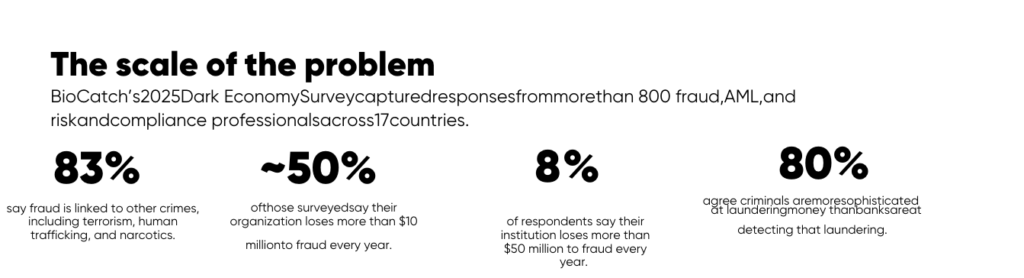
Disrupting the Dark Economy requires all of us to do more than just stop fraud. The industry must instead approach this $3.1 trillion problem from all sides: We detect fraud and scams on the sending side of a transaction and money mule accounts on the receiving end. By detecting mules at scale, protecting victims from exploitation, and uniting fraud and AML teams through a shared behavioral lens, the global community of fraud fighters can take meaningful action. Explore the full findings of BioCatch’s 2025 Dark Economy Survey to learn more about the present challenges identified by fin crime leaders around the world and how they think the industry ought to address those problems
| Tagged with: | fraud |
| Posted in: | AF Education |